
Rust-Based Terminal Monitoring for Real-Time Sequencing Operations
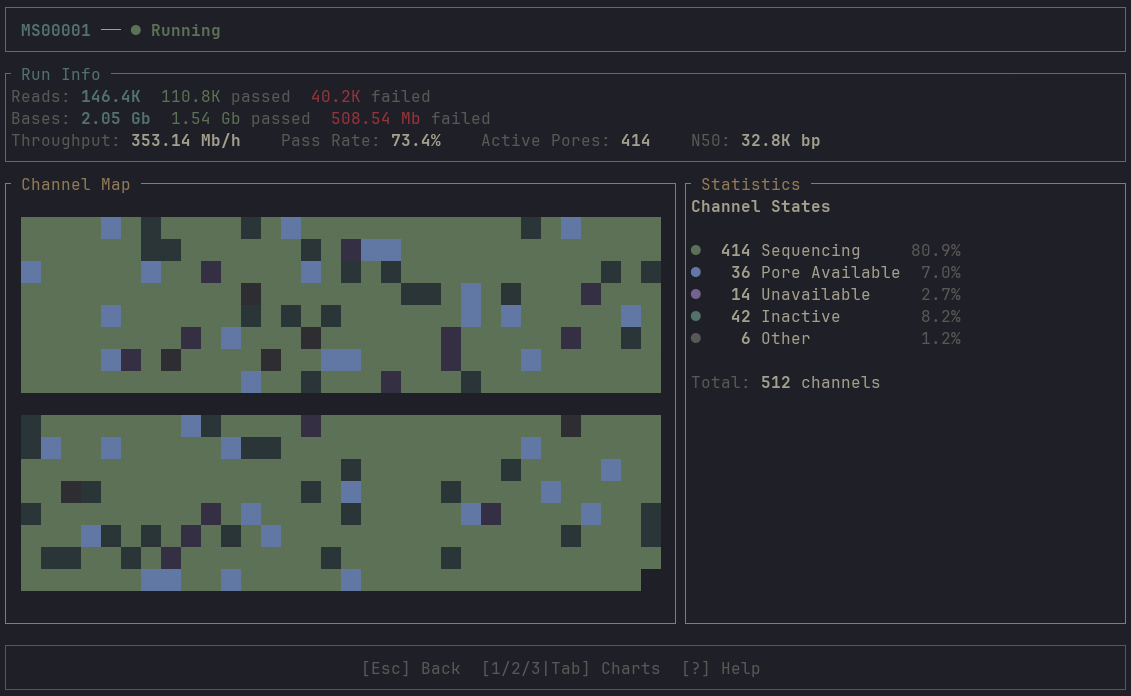
Termion is an open-source terminal user interface (TUI) built in Rust for real-time monitoring and control of Oxford Nanopore sequencing runs. It connects directly to MinKNOW—Oxford Nanopore’s device control software—via gRPC, streaming live telemetry into any SSH session.
The project was developed while I was serving as a software engineer at Jonah Ventures and is deployed in production to support GridION sequencing operations.
The Problem
Oxford Nanopore sequencers generate continuous data streams over runs lasting 24–72 hours. MinKNOW provides a web-based GUI, but remote access typically requires VNC, X11 forwarding, or browser-based sessions—each introducing latency, operational complexity, or security tradeoffs.
The lab needed a lightweight, low-latency way to:
- Monitor sequencing progress in real time
- Assess flow cell health
- Track throughput and quality metrics
- Pause or stop runs when necessary
All without relying on browser interfaces or graphical remote sessions.
The Solution
Termion provides a keyboard-driven interface accessible over any SSH connection. It streams telemetry directly from MinKNOW’s gRPC API and renders live visualizations in the terminal.
Capabilities include:
- Live throughput charts tracking reads and bases over time
- Channel activity heatmaps showing pore states across all channels
- Read length histograms with real-time N50 calculation
- Run control (pause, resume, stop acquisition)
- Support for MinION, GridION, and PromethION devices
The result is a lightweight operational dashboard that can run in any terminal, including remote sessions and headless environments.
Technical Architecture
I chose Rust for its performance characteristics and memory safety guarantees, particularly important when handling high-volume streaming telemetry.
The system uses:
- Tokio for asynchronous I/O
- tonic for gRPC communication with MinKNOW
- ratatui for structured terminal rendering
The architecture separates the gRPC client layer from the TUI rendering logic, with domain-level abstractions insulating the interface from raw protobuf structures.
Reconnection logic with exponential backoff ensures resilience against transient network interruptions, and the rendering loop is optimized to handle high-frequency updates without excessive CPU usage.
Context & Deployment
Termion was deployed at Jonah Ventures to provide daily visibility into sequencing operations. Lab technicians and bioinformaticians use the tool to monitor run status, assess quality metrics, and intervene when necessary—all directly from terminal sessions.
The project demonstrates how lightweight, performance-oriented tooling can improve operational reliability without introducing additional infrastructure complexity.